Photo: AndersKjærbye/fodboldbilleder.dk
Tactical and Mental Preparation
For Victor, the key to success is good preparation and mental resilience—not just physical
resilience. Victor always prepares the same way, whether he’s playing against FC Barcelona or a bottom-of-the-table team,
. This adjustment can be difficult and requires consistent routines;
“I always prepare the same way. Of course, I eat and sleep well. I meditate. I talk to just one person—I have a rule that I only talk to one person on game day. And that’s my mental coach. It’s important to prepare the same way. It can be a tough transition to play against Barcelona on Thursday and a bottom-of-the-table team on Sunday. The transition is harder than it seems. Certain patterns emerge. But I always prepare well by focusing on what I can control: food, sleep, and hydration.”
Before each match, Victor prepares for the specific opponent he’ll be facing so that he
knows what moves his opponent makes. In the Europa League match against FC Barcelona, there was
a special focus on the running patterns of two forwards when they receive the ball;
“So I always—no matter who it is—watch video of the direct opponents I’m going to face. For example, against FC Barcelona, it was Aubameyang. Every player has certain characteristics. It’s good to see and know that, because when the situation arises in a match—and it all happens very quickly—you’re better prepared. For example, against Aubameyang and Memphis Depay, I knew that they both like to sprint toward the ball and then turn around to make a run into space. So when I played against Barcelona, I recognized the situation. So when Memphis accelerated three or four meters down the field, I knew in the back of my mind that he’d turn and run deep. Every player has two or three moves they tend to make most often. But I always watch video of the direct opponents I’m going to face. And then, of course, as a team, we also analyze the entire team we’re going to face.”
Keeping the hunger alive
In addition to focusing on the mental aspect, Victor also places great emphasis on constantly developing as a
soccer player, and he is very careful not to become too complacent with what he has achieved so far
, since, according to Victor, that would simply put a stop to the development he is well on his way to achieving. To that end
, Victor also finds inspiration outside of soccer;
“The idea of never being satisfied. Always going to training to get better—and that’s also why, at a young age, when I was 19, I started working with a mental coach. I couldn’t understand it—it’s something that’s not really a thing in Denmark. If you ask any young players—or even people in the Superliga—they’ll say, ‘Yeah, I’m mentally strong.’ But there’s so much more to it than that. I realized early on that this was something I needed to do to improve myself. I couldn’t understand why all the great athletes in various sports—like Michael Phelps, Kobe Bryant, LeBron James, and Tiger Woods—said that 80% is in your head and 20% is skill. What does that mean? I wanted to learn more about that.”
In addition to constant mental development, Victor also believes that, as a
soccer player, you must never become “too satisfied” with what you have right now—which is especially true when you’re a
young player;
“I think—especially when you’re young, and I’m not done developing and playing for major European teams—but the danger of getting too complacent and feeling comfortable where you are. I think that’s the biggest trap you can fall into. I could just sit back—I have a four-year contract left here at Galatasaray—and say, ‘Yeah, everything’s great right now, and it’ll all work out.’ That’s the biggest trap—especially for a young player—to fall into. That’s why I started working with a mental coach very early in my career.”
Life on the Field
Over the years, Victor has played against quite a few major clubs and soccer players, and there are a number of
soccer players who have made a lasting impression on him and continue to inspire him today.
“I have a lot of (other soccer players, ed.) that I look up to and can learn from, but no
—real idols.”
In particular, there are three top-tier defenders that Victor has his eye on—players who have inspired h
—and he has even played against one of them;
“Sergio Ramos. And in recent years, Virgil van Dijk of Liverpool has also been a great player. A player named José Giménez from Atlético Madrid, who is from Uruguay
.”
“I’ve played against Virgil. I haven’t faced the other two, either at the club or on the national team. Not yet, at le
.”
Over the years, Victor has faced many great strikers who have made an impression on him
. But there is one player from a specific period of Victor’s career who posed a major challenge. Victor
particularly remembers that, in his early days in the Superliga, he had many tough matches against Brøndby
IF’s Teemu Pukki;
“The player I had the hardest time marking, at the time, and the hardest to play against—
—is actually him, and I was also quite a bit younger then, but when I was 17 or 18, I had to mark Teemu Pukki from Brøndby
. I remember that he moved differently than other forwards in
the Superliga. He was tough back then, but if I were up against him now, I’d eat him alive,
but when I was 18, I remember it was really tough. It was a pain when I had to face him. He was
a real threat back then. Great player.”
As a defender, there’s a lot of physical back-and-forth during matches, which also feature plenty of
close-quarters battles in the box. One player in particular has made an impression on Victor with some dirty tricks;
“It’s a bit unusual, actually, but I’d have to go with Anthony Martial from Manchester United. He was a bit rough. He liked to—it’s one of those tricks you learn—I remember him digging his fingernails into my ribs. He had some pretty rough moves. He’s a good player, too.”
Daily Life as a Professional and Dreams for the Future
Life in Turkey is quite different from what Victor is used to in Denmark, where the trip to practice is now
with a driver, since Istanbul—a city of millions—is a traffic nightmare. As a soccer player,
’s daily routine usually follows a set schedule, which Victor also adheres to at Galatasaray;
“I wake up around 8:30 a.m. and get picked up at 9:00 a.m., and then I have an hour-long ride to practice. My driver comes to pick me up. I arrive at the facility around 10:00. When I get to the club, I eat breakfast. I train at 11:00, do a little pre-workout in the gym beforehand, and then head out onto the field. Then I train, and afterward I go back to the gym to take care of my body and do strength training. I eat lunch. I’m back home around 3:00 or 4:00.”
Right now, Victor is enjoying life at Galatasaray and in Istanbul, where he’s a regular on the Turkish
team, but one day in the future, Victor hopes to move to an English or Italian
city;
“I see myself at a top club in England or Italy (in 5 years, ed.); that’s where I’d like to go.”
The best advice for up-and-coming stars
Victor also believes that hard work and good preparation are crucial if, as a young
soccer player, you want to become a professional like Victor one day. But Victor also thinks it’s important
to remember that the path to becoming a professional soccer player also requires making some difficult social sacrifices at a
young age;
“I think that when you’re young, you have to work hard and be determined. Tell yourself—and make a promise to yourself—‘Listen, I want to be a soccer player, and I’m going to do everything I can to make it happen.’ And when you become a soccer player—or during the process of getting there—there are tons of things you miss out on. Friendships that fall by the wayside. A lot of fun evenings with friends—you’ll miss out on those. That’s the flip side of the coin. You have to accept that. But if you make it to the other side, I promise you, it’ll be worth every bit of it.”
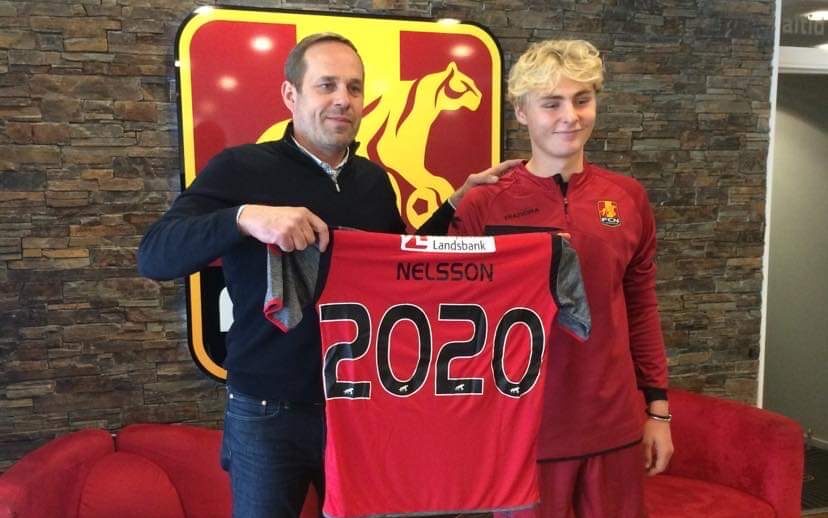
When Victor looks back on his career so far, he has no doubt that it was life as a
professional soccer player that he dreamed of when he himself was running around the fields in North Zealand as a
youth player;
“I did manage to become a professional soccer player, and that’s the big goal, after all. A professional soccer player
can play for anywhere from FC Nordsjælland to FC Copenhagen to Galatasaray. But just the fact that
I could make money playing soccer—that was really what mattered to me. I really wanted that. He would
be happy and proud of what he’s achieved so far.”
In the portrait series “From Grassroots to Elite,” we follow the journey of former Kronborg Cup participants from grassroots soccer to elite soccer. The Kronborg Cup is a grassroots tournament that embraces and celebrates the sense of community and the breadth of the sport, where there is room for everyone. We celebrate the talent that goes all the way from dreams to a life in elite soccer at the highest level.